
Picture this: You arrive at a concert venue to see your favorite artist. The lights dim, the crowd buzzes, anticipation builds. They finally step on stage and perform the entire set with their hands stuck in their pockets. No gestures. No movement. No visible energy. Even if the music sounds incredible, something feels off. You’re listening, but you’re not fully feeling it. The performance lacks presence, connection, and impact. You leave entertained (maybe), but not moved.
Whether or not you use your hands as a tool to command a room can be the difference between an impactful presentation and a forgettable one. Talking with your hands is a form of nonverbal communication that won’t replace your words, but can determine how your words are received. Research from Pepperdine University on nonverbal communication shows that audiences form judgments about confidence and credibility before a speaker finishes their first sentence. Hand gestures are one of the most visible cues influencing those judgments.
In this blog, I’ll teach you how to look more confident without saying anything. Then, we’ll explore how to make your ideas more memorable using visual emphasis. Lastly, we’ll reflect on how to replace nervous habits with purposeful movement. Let’s dive in.
Point 1: Look More Confident without Saying Anything
Body language experts have found that we unconsciously measure a person’s competence in the first few moments of meeting them. In an interview with bestselling author and professional speaker, Vanessa Van Edwards, she talks about how people use body language and non-verbal cues alone to measure a person’s competence. I experienced this firsthand at a church I attended. The pastor was deeply educated in biblical history, but his delivery told a different story. He wasn’t talking with his hands at all. In fact, his hands stayed tucked in his pockets and he remained planted in one spot on stage throughout the sermon. Despite the depth of his knowledge, the lack of visible confidence made the message harder to engage with.

When confidence isn’t physically expressed through different kinds of gestures, even the most competent message can lose its power. Something we teach in our public speaking class, Fearless Presentations®, is to drop your hands. Open palms are a nonverbal shortcut to trust. They communicate confidence, trust, and credibility without you saying a thing. This is the foundation of talking with your hands in a confident and controlled manner.
One of the most powerful ways to look confident without saying a word is by using your body in a natural way to influence the people around you. This is a phenomenon known as the Nervous System Mirror Effect. It refers to the way humans subconsciously sync with the emotional and physiological state of others. Our brains and nervous systems are wired to read cues like posture, movement, breath, and facial expression, and then mirror them. In simple terms: a regulated, calm person with positive body language can help regulate others, while a tense or closed-off person can unintentionally spread that tension.
Confidence Isn’t What You Say, It’s What You Show
Think about the last time you were in a stressful meeting or waiting for a presentation to start. The room feels tense, people are shifting in their seats, and your shoulders are tight. Then, the speaker walks in, smiling warmly, making gentle hand gestures as they greet the group or outline the agenda. Suddenly, the tension in the room eases. You breathe a little easier, lean forward, and feel more engaged. You didn’t hear any words yet, but their hands and facial expressions set the tone, signaling, “This is safe. You can relax and focus.”
Facial expressions, like a relaxed smile or open eyes, work hand-in-hand with gestures to amplify your message. When you talk with your hands and become more active (pointing, illustrating, or emphasizing key ideas) paired with a confident, approachable expression, the room naturally mirrors that energy. Together, your hands and face become a silent but powerful language, helping you be heard, felt, and remembered.
The bottom line is this: confidence isn’t just what you say, it’s what you show. Every movement sends a signal to the people around you.
Point 2: Make Your Ideas More Memorable with Visual Emphasis
When I was in college, we were required to take a General Education Health class. My teacher came in one day with a chart and cups to depict how much sugar is in everyday drinks we consume, like soda, juice, and chocolate milk (Google: “Rethink Your Drink” for a comparative visualization). She was helping us visualize what her words alone couldn’t. Visual aids are also a great way to give the speaker a brief cognitive break. Shifting some of the audience’s focus away from the speaker for a moment can reduce anxiety and help the speaker reset so they can continue with strong stage presence.
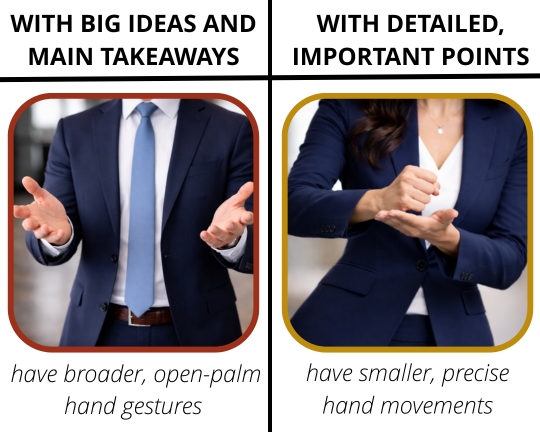
Just like the cups of sugar made an abstract number tangible, talking with your hands helps audiences see your message, not just hear it. When ideas have size, contrast, or movement, your hands can give them form. Mismatched hand gestures can dilute your message or create confusion, so use them intentionally for the points that matter most.
Point 3: Replace Nervous Habits with Purposeful Movement
If you watch enough TED Talks, you’ll start to notice a pattern: the least popular speakers often aren’t struggling with what they say, but how their silent language lands. Nervous habits, like repetitive pacing, swaying, or fidgeting, can quietly erode credibility and distract an audience member from the message itself. Viral speakers, on the other hand, tend to replace these unconscious movements with intentional ones.
The difference between talking with your hands in a purposeful manner and nervously fidgeting can be very obvious to your audience. A general rule is this: if a movement doesn’t clarify, emphasize, or support an idea, it’s probably a habit, not a gesture. By observing yourself (or watching a recording) and reflecting on where you move out of nervous energy rather than purpose, you create the opportunity to swap those habits for gestures that actually serve your message.
Stillness is a Power Move
One of the most overlooked (and challenging to master) tools in the silent language of leaders is stillness. Megan Fate Marshman, a speaker, author, and pastor, demonstrates this beautifully. She doesn’t feel the need to constantly move or use gestures to hold attention. Instead, she allows moments of stillness and silence to do the work. When she makes a big point, she pauses (verbally and physically). For an audience member, this reads as confidence, clarity, and authority. While many TED Talks showcase dynamic movement, the most impactful speakers know when not to move. The general rule here is simple: purposeful stillness can be just as powerful as purposeful gestures. When you’re comfortable standing still, you signal that your presence alone is enough. That’s often what separates viral speakers from the rest.
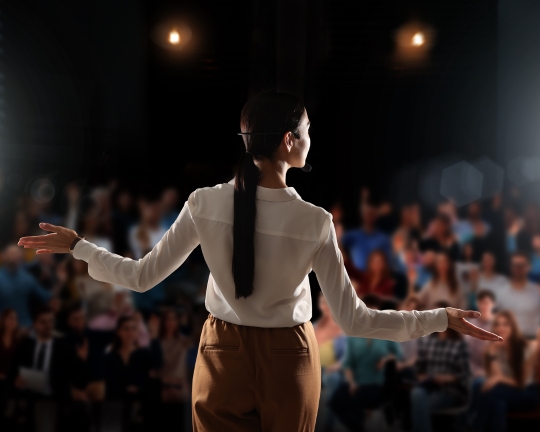
“Confidence isn’t something you have. It’s something you do.” Vanessa Van Edwards’ words perfectly capture the heart of using hand gestures with intention. Presence on stage isn’t about feeling fearless, it’s about behaving in ways that signal confidence before you ever open your mouth.
To recap, when you look more confident without saying anything, your body becomes your first message to immediately shape how your audience perceives you.
✔️ Grounded posture
✔️ Open hand gestures
✔️ Intentional stillness
By making your ideas more memorable with visual emphasis, you turn abstract thoughts into something people can see and remember (your hands are living visual aids to reinforce what matters most).
When you replace nervous habits with purposeful movement, you reclaim your body as an asset rather than a distraction, allowing your message to take center stage. Used well, talking with your hands won’t just support your words, they amplify them. Confidence, clarity, and connection are built through small, repeatable actions. And the more intentionally you use your gestures, the more your presence speaks for you— long before the audience hears a single word.